Floral Foam: Is It Bad for the Environment? (Plus 8 Sustainable Alternatives)
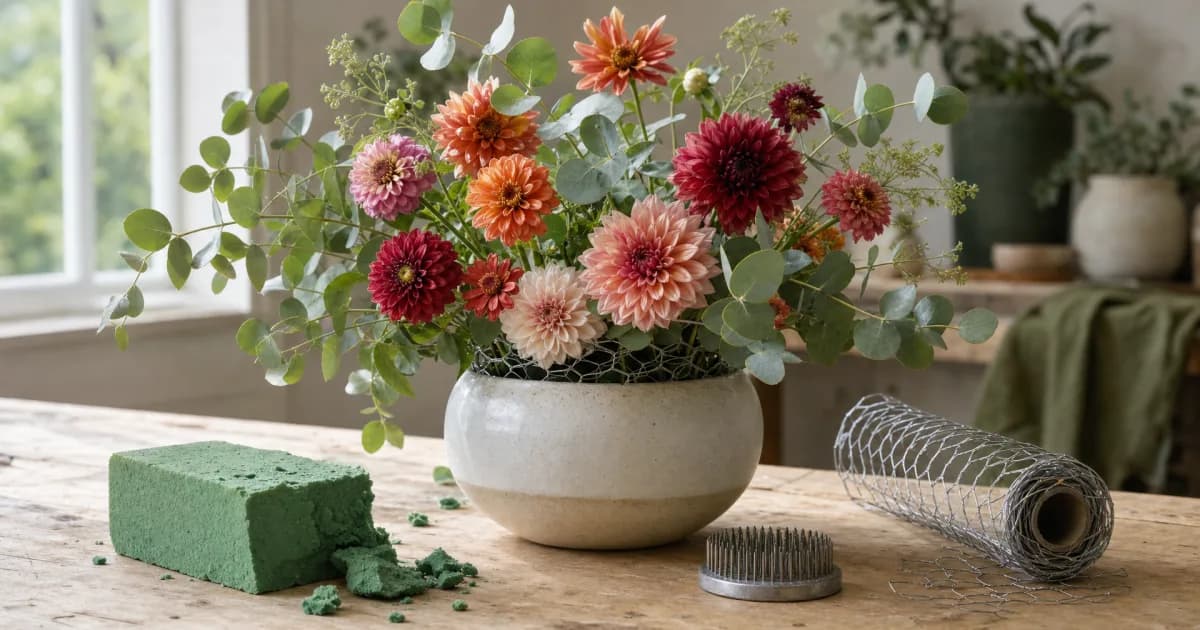
That dense green brick most flower arrangements are built on? It's plastic. Floral foam — the spongy block florists soak in water and push stems into — is a single-use plastic that never fully breaks down. As more florists rethink their footprint, it's become one of the first things to go. Here's what floral foam actually is, why it's a problem, and the foam-free alternatives that work just as well.
What is floral foam, exactly?
Floral foam — you may know it by the brand name Oasis — is a lightweight, water-absorbent material that anchors flower stems while keeping them hydrated. It was invented in the 1950s and quickly became the backbone of modern floristry. A single block can hold dozens of stems at precise angles while feeding them water, which is exactly why it took over.
The catch is what it's made of. Floral foam is a phenol-formaldehyde plastic — a set of resins foamed into that familiar crumbly brick, chemically related to the plastics used in insulation. So while it looks and feels like a natural sponge, it behaves like plastic.
Is floral foam bad for the environment?
In a word, yes. Floral foam is a single-use plastic, and like other plastics, it doesn't biodegrade. A used brick that goes in the bin sits in landfill more or less indefinitely.
The bigger issue is that foam is brittle and crumbles easily — and those crumbs are microplastics. Rinse a foam-based arrangement at the sink or hose down a workbench, and you're washing plastic particles straight into the water system. Research on floral foam has found that it sheds microplastic fragments, and lab studies have shown those particles can be ingested by aquatic organisms and affect their development.
Then there's the sheer scale. Floristry runs through an enormous amount of foam — every funeral tribute, wedding centerpiece, and weekly corporate arrangement often starts with a fresh brick that's used once and thrown away. The case against it has grown strong enough that the Royal Horticultural Society moved to ban floral foam from its flower shows, including the Chelsea Flower Show, as part of a wider sustainability push.
Is floral foam toxic to handle?
Floral foam contains formaldehyde — a recognized carcinogen — along with carbon black and other compounds. The dust from cutting dry foam is an irritant, and florists who work with it regularly are advised to wet it before cutting, avoid breathing the particles, and wear gloves. It's worth being clear on one point: floral foam is not safe to compost, and it should never be used in anything that grows food.
Why florists relied on foam in the first place
Foam earned its place for real reasons, and it helps to understand them before you give it up. You soak a brick in water — letting it sink under its own weight rather than forcing it down, which leaves dry pockets — then cut it to fit a container. From there you can set a stem at almost any angle and it stays exactly where you put it, fed by the water held in the foam.
For complex shapes, hanging installations, and big event work, that control is genuinely useful, and giving it up means relearning how you hold an arrangement together. The good news: florists have been doing precisely that for years now, and the alternatives have caught up.
8 sustainable alternatives to floral foam
None of these is exotic, and most cost less than a steady habit of single-use bricks because you reuse them again and again.
- Chicken wire. The workhorse of foam-free floristry. Crumple a piece of galvanized or coated chicken wire into a loose ball and fit it inside your vessel; stems weave through the grid and hold their angle. One piece lasts for years.
- Pin frogs (kenzan). A heavy metal base studded with sharp pins, borrowed from Japanese ikebana. You press stems onto the pins, and the weight keeps everything stable — ideal for shallow bowls and minimalist designs. Effectively reusable forever.
- Flower frogs. Glass, ceramic, or metal frogs with holes or a caged top sit in the bottom of a vase and give each stem a slot. They double as a vintage-looking detail in clear vessels.
- A floral tape grid. The cheapest option of all: crisscross waterproof floral tape across the mouth of a vase to create small pockets that hold stems in place. No special kit, and you compost nothing but a little tape.
- Reusable cages and water tubes. For arches and large installations, reusable plastic or metal cages (often filled with chicken wire or moss) and individual water tubes — also called water picks — keep stems hydrated without a scrap of foam.
- Moss and natural armatures. Bind moss, willow, or pliable branches into a base structure — an "armature" — that cradles stems. When the arrangement is done, the whole thing composts.
- Compostable foam-free products. A handful of purpose-built alternatives now exist for big pieces, such as the refillable, compostable Oshun Pouch and stem-holding mats made from natural fibers. They replace foam in installations without the microplastic baggage.
- No mechanics at all. Often the simplest answer. A hand-tied bouquet or a loose, gathered vase arrangement needs no internal support — and seasonal, garden-style flowers lend themselves beautifully to this looser look.
What about "biodegradable" floral foam?
Manufacturers now sell "biodegradable" foam, and it sounds like a tidy fix. Read the fine print, though. Most versions break down only under specific conditions — biologically active landfill or industrial composting — not in a home compost bin, a garden bed, or the ocean. Sustainability groups and independent testers have pushed back hard on these claims, arguing they're closer to greenwashing than a genuine solution. If your goal is to avoid the microplastic problem, the most reliable route is to skip foam altogether rather than swap one foam for another.
How to start arranging without foam
You don't have to overhaul everything at once. Most florists who've made the switch start with the easy wins — the vase arrangements and hand-tieds that never needed foam in the first place — then build up a small kit of reusable mechanics for the trickier work: a couple of pin frogs, a roll of chicken wire, a few reusable cages.
Compost your green waste, reuse your mechanics, and you'll quietly remove a surprising amount of plastic from your studio. Customers increasingly notice and appreciate it, too — foam-free has become a selling point rather than a compromise.
Foam-free is a hallmark of a sustainable florist
Of all the choices a florist makes, going foam-free is one of the clearest signals that their sustainability claims are real. If you'd rather your flowers didn't come with a hidden brick of plastic, look for florists and growers who describe their work as foam-free or built on "sustainable mechanics." Many of the small, local growers behind seasonal flowers work this way by default.
Find a foam-free, eco-friendly florist near you
Browse verified eco-friendly florists and flower farms by state, many of whom build arrangements the foam-free way.
Browse by State